

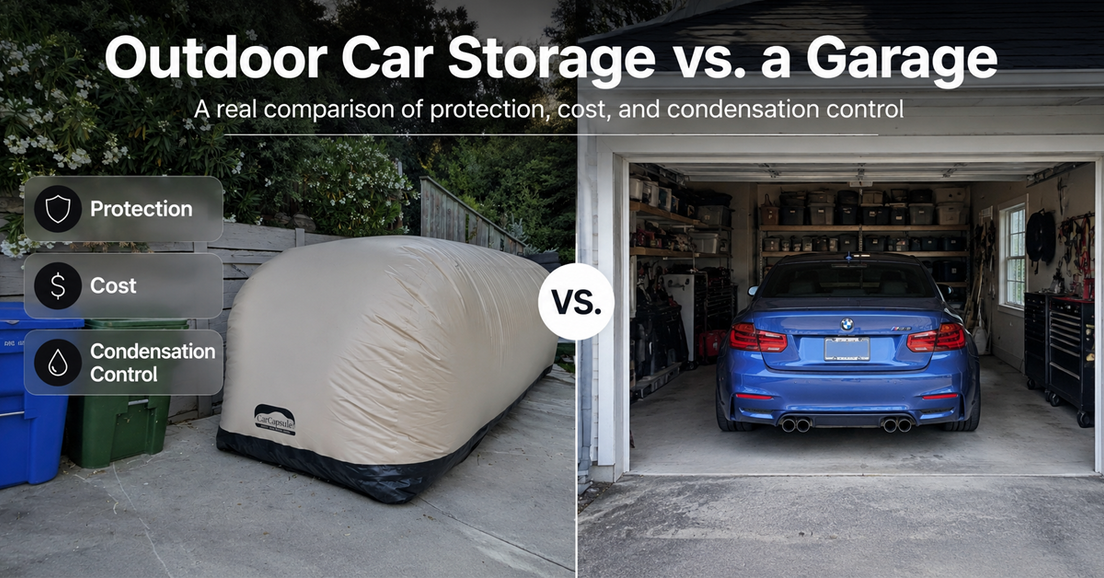
Outdoor Car Storage vs. a Garage: Which Actually Protects Your Vehicle Better?
Posted by Phil Potocki on 29th May 2026
A classic Porsche 911 left under a basic tarp for one winter came out with surface rust on the brake rotors, a rodent nest behind the dashboard, and paint oxidation on the hood. The owner had a garage - he just ran out of space. That scenario plays out thousands of times every year, and it's exactly why the question of outdoor car storage deserves a real answer, not a "rent a unit near you" redirect.
This post breaks down three real options for storing a vehicle outside a traditional garage: a commercial storage facility, a carport or open structure, and an at-home inflatable vehicle capsule. You'll get a direct comparison on humidity control, UV exposure, condensation risk, pest protection, cost, and long-term paint preservation - so you can make a confident decision before the next season hits.
Why Your Garage Isn't Always the Safest Option Either
This might surprise you: a standard attached garage is often worse for long-term vehicle storage than people assume. Concrete floors release moisture vapor year-round. Temperature swings between a cold night and a warm afternoon create condensation cycles directly on your paint and inside your engine bay. A study from the University of Minnesota's Building Science Division found that uninsulated garages can experience relative humidity swings of 40 percentage points in a single day during spring and fall - the exact windows when most collectors transition their vehicles.
A garage keeps rain off. It does not automatically regulate humidity, filter airborne dust, or prevent the slow corrosion that comes from trapped moisture. If you're storing a Corvette, a classic Mustang, or a restored Mopar in an unventilated garage and calling it "protected," you're managing one risk while ignoring three others.
So when the comparison is outdoor storage versus a garage, the honest answer is: it depends entirely on what the outdoor solution actually does.
The Three Real Outdoor Car Storage Options
Option 1: Commercial Vehicle Storage Facilities
Facilities like Extra Space Storage and U-Haul dominate the search results for "outdoor car storage" because they have the marketing budget to be everywhere. What they don't have is a compelling answer for the enthusiast who wants genuine vehicle protection.
Outdoor lots at commercial facilities are exactly what they sound like: a paved or gravel lot with a fence around it. Your car sits exposed to UV radiation, bird droppings, tree sap, rain, hail, and temperature extremes. The security camera monitors the lot, not your paint. Most facilities explicitly disclaim liability for weather damage.
Indoor climate-controlled units are a better option, but they run $150 to $400 per month depending on market and unit size. That's $1,800 to $4,800 per year for a space you don't own, can't customize, and have to drive to every time you want to check on your vehicle. For a collector running two or three vehicles, the annual cost stacks quickly against buying a permanent home solution.
What facilities do well: Security lighting, fencing, and insurance eligibility for stored vehicles.
What they miss entirely: Humidity control, condensation prevention, dust filtration, and rodent exclusion in outdoor lots.
Option 2: Carports and Open Structures
A steel carport or fabric canopy solves the UV and rain problem at a fraction of the cost of a permanent garage. Entry-level steel carports run $800 to $2,500 installed. Fabric canopies are cheaper but typically last three to seven years before the cover degrades from UV exposure.
The limitation is everything a roof doesn't cover. Wind-driven rain, blowing dust, insects, and rodents still have full access to your vehicle. Humidity is entirely uncontrolled. A car sitting under an open carport in the Southeast or Pacific Northwest is going to accumulate moisture-related damage at nearly the same rate as one sitting on a driveway.
For a daily driver or a work truck, a carport is a reasonable investment. For a collector car or a vehicle you're actively preserving, it's a partial solution that leaves the most damaging threats unaddressed.
Option 3: An Inflatable Vehicle Storage Capsule
This is the option the storage facility websites cannot credibly discuss, which is why they don't. CarCapsule invented the inflatable vehicle storage category in 1991 and has held the patent since. The concept is straightforward: a sealed clear PVC enclosure inflated by a continuously running filtered fan system that maintains positive air pressure inside the capsule.
That positive pressure does two things. First, it keeps outside air - carrying dust, pollen, humidity, and insect larvae - from entering the enclosure. Second, the continuous airflow prevents condensation from forming on the vehicle's surface, which is the primary mechanism behind paint damage, rust formation, and interior mildew in stored vehicles.
The Outdoor CarCapsule is specifically engineered for vehicles stored without a garage. It uses a UV-resistant outer shell and a dual-fan system with replaceable filters to maintain that protective airflow around the clock. Owners have documented outdoor use exceeding a decade - including one BikeCapsule owner whose unit lasted 12 years of continuous outdoor exposure with the vehicle inside in preserved condition.
Motor Trend named CarCapsule one of the Top 10 Most Innovative Car Care Products, and the system backs that recognition with a one-year warranty and optional Affirm financing so the cost doesn't hit all at once.
Head-to-Head Comparison: What Actually Protects Your Vehicle
| Protection Factor | Commercial Outdoor Lot | Carport / Canopy | Outdoor CarCapsule | Standard Garage |
|---|---|---|---|---|
| UV Protection | None | Partial (roof only) | Full (UV-resistant shell) | Full |
| Rain / Hail | None | Partial (roof only) | Full enclosure | Full |
| Humidity / Condensation Control | None | None | Active (filtered airflow) | Poor to moderate |
| Dust / Pollen Exclusion | None | None | Active (positive pressure seal) | Partial |
| Rodent / Pest Exclusion | None | None | Full (sealed enclosure) | Partial |
| Vehicle Visibility / Display | None | Open | Full (clear PVC) | Depends on setup |
| Annual Cost | $1,800 to $4,800 (rented) | $800 to $2,500 (purchase) | One-time purchase | Sunk cost (already built) |
| Requires Garage / Structure | No (off-site) | Partial | No (driveway-ready) | Yes |
The Condensation Problem Nobody Talks About
Most outdoor storage conversations focus on rain and UV. Condensation gets ignored because it's invisible until the damage is done.
Here's what actually happens when a vehicle sits in an enclosed space without active airflow: overnight temperatures drop, the metal surfaces of your vehicle cool faster than the ambient air, and moisture vapor in the air precipitates on those surfaces. This happens inside a garage, inside a storage unit, and under a car cover. It happens every night the temperature swings more than about 15 degrees Fahrenheit.
Over a storage season, that cycle deposits and evaporates moisture hundreds of times across your paint, your brake rotors, your undercarriage, and your engine bay. The result isn't dramatic - it's the slow oxidation and micro-pitting that strips value from a collector car between the day you park it and the day you pull it out.
CarCapsule's evaporative storage technology addresses this directly. The filtered fan runs continuously, moving air through the enclosure in a way that prevents the surface temperature differential that causes condensation. It's the same principle used in museum-grade artifact storage, applied to vehicle preservation.
A flat tarp, a carport, and a standard storage unit don't do this. A sealed inflatable capsule with active airflow does.
Rodents: The Threat Every Storage Article Skips
According to the Insurance Information Institute, rodent damage to vehicles is one of the most commonly filed comprehensive claims - and the problem spikes dramatically during storage seasons when mice and squirrels seek warm, sheltered environments. Wiring harnesses, air filter housings, and insulation materials are particularly vulnerable.
A commercial outdoor lot provides zero rodent protection. A carport provides zero. Even a standard garage is frequently breached - concrete foundations develop gaps, and a mouse can fit through an opening the diameter of a pencil.
A sealed, positively pressurized enclosure like the Outdoor CarCapsule provides a physical barrier that rodents cannot penetrate without defeating the continuous airflow seal. That's not a marketing claim - it's basic physics. A space maintained at positive pressure relative to the outside has no entry points that work passively. Rodents can't chew through pressurized air.
Cost Analysis: What You Actually Spend Over Five Years
Run the numbers honestly before assuming a commercial storage facility is the budget option.
- Commercial outdoor lot: At $100 per month average nationally, you'll spend $6,000 over five years. You own nothing at the end, and the vehicle received no active protection.
- Climate-controlled indoor unit: At $250 per month, that's $15,000 over five years. Still renting. Still driving to a facility to access your own vehicle.
- Carport (steel, installed): $1,500 to $2,500 up front, no ongoing cost but no active protection and potential permit requirements depending on your municipality.
- Outdoor CarCapsule: A one-time purchase that stays on your property. The 20-foot Outdoor CarCapsule fits most sedans and coupes; the 24-foot Tall model accommodates trucks and SUVs. No monthly fees. Affirm financing available to spread the cost.
The break-even point against a $100/month outdoor lot is typically under 18 months. After that, the capsule is pure savings while delivering measurably better protection.
Matching the Right Capsule to Your Vehicle
The practical rule is simple: choose a capsule that gives your vehicle approximately two feet of clearance on each end. A 16-foot vehicle fits comfortably in an 18-foot or 20-foot capsule. A full-size truck or SUV generally needs the 22-foot or 24-foot Tall model.
For motorcycles, the 9-foot Outdoor Bike Showcase was built specifically for outdoor motorcycle storage and handles the same condensation and UV threats at a scale appropriate for two wheels.
Boats have a dedicated solution too: the 25-foot Outdoor Boat Capsule applies the same sealed-airflow approach to watercraft stored between seasons.
Not sure which size fits your specific vehicle? Call CarCapsule directly at (219) 945-9493 for sizing guidance. The team has been doing this since 1991 and can match you to the right unit without the upsell runaround.
What a Garage Does Better (Honest Answer)
A well-insulated, climate-controlled garage with a dehumidifier running is still the gold standard for vehicle storage. Full stop. If you have that setup, use it.
Where a garage loses the comparison is in cost (a climate-controlled garage addition runs $30,000 to $70,000 to build), availability (most homeowners have one bay and two or more vehicles to store), and the assumption that "inside" equals "protected" when the garage itself has humidity and condensation problems.
For collectors with multiple vehicles, the Outdoor CarCapsule is the realistic answer for vehicles that don't fit inside. For anyone without a garage at all, it's the closest available equivalent to building one - and it delivers better active protection than most unimproved garages actually provide.
Read the deeper breakdown in CarCapsule's own analysis: Is the Outdoor CarCapsule Better Than a Garage?
The Bottom Line
If you're comparing outdoor car storage options and your priority is actual vehicle preservation, not just keeping rain off the roof, the Outdoor CarCapsule is the only at-home solution that addresses the full set of threats: UV, rain, hail, dust, humidity, condensation, and rodents simultaneously.
Commercial storage facilities protect your car about as well as a parking lot with a fence. Carports solve one problem while leaving five others open. A standard garage is better but comes with its own condensation limitations and the hard constraint of available space.
CarCapsule has been solving this problem since 1991. The technology works, the track record is documented, and the math on cost versus a rented storage unit is straightforward. Explore the full line of CarCapsule outdoor storage solutions to find the right fit for your vehicle - or call (219) 945-9493 if you want to talk through sizing before you buy.
Frequently Asked Questions
Is outdoor car storage safe for a classic or collector vehicle?
Outdoor storage is safe for a collector vehicle if the storage solution actively controls humidity and blocks UV, dust, and pests. A plain tarp or open carport is not adequate. An inflatable capsule with continuous filtered airflow, like the Outdoor CarCapsule, creates a sealed microenvironment that prevents the condensation cycles and particulate buildup that degrade paint and mechanical components during long-term storage.
How does an inflatable car capsule compare to a standard car cover?
A car cover sits directly on the paint surface and can trap moisture underneath, particularly during temperature swings. It also allows dust to migrate under the edges over time. An inflatable capsule maintains an air gap around the entire vehicle while positive pressure keeps outside air out. The result is a storage environment that prevents condensation and dust accumulation rather than just deflecting rain.
What is the cheapest long-term outdoor car storage option?
Calculated over five years, an at-home inflatable capsule is consistently cheaper than a rented outdoor lot. A commercial outdoor unit at $100 per month costs $6,000 over five years with no residual value. A one-time capsule purchase carries no ongoing fees and can be reused across vehicles. The break-even against a $100/month facility is typically under 18 months.
Can you store a car outside in winter without a garage?
Yes, with the right enclosure. The Outdoor CarCapsule is rated for all-season use including hail, sleet, and snow. The key is maintaining active airflow inside the enclosure to prevent condensation, which is the primary cause of winter storage damage. Simply parking a vehicle under a tarp or cover in winter traps moisture and accelerates rust and paint degradation.
How do I choose the right outdoor car capsule size?
Measure your vehicle's overall length and add approximately two feet of clearance on each end. A 16-foot car fits well in an 18-foot or 20-foot capsule. Trucks and full-size SUVs typically need a 22-foot or 24-foot model. For exact sizing on your specific vehicle, CarCapsule's team is reachable at (219) 945-9493.