

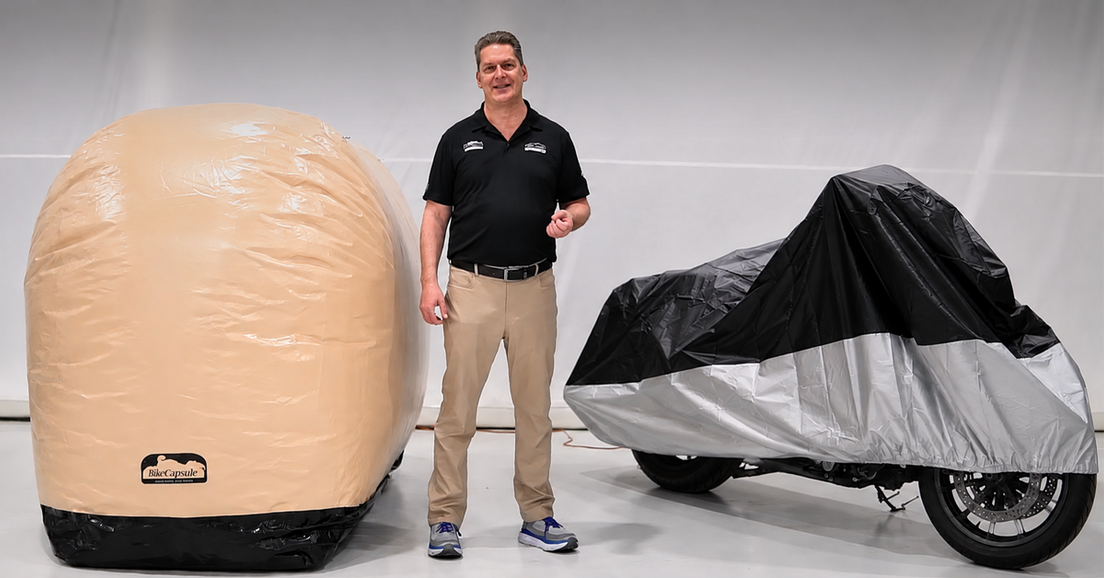
Motorcycle Storage Pod vs. Traditional Motorcycle Cover: Which Actually Protects Your Bike?
Posted by Phil Potocki on 3rd Aug 2026
A flat cover left on a motorcycle through a single humid winter can trap enough condensation to start surface rust on chrome and corrode electrical connections before spring. Most riders don't discover the damage until they pull the cover off in March. That's not a storage solution. That's a slow-motion problem.
This post breaks down exactly what separates a motorcycle storage pod from a traditional cover, where each one genuinely performs, and which one a serious rider should trust with a bike they actually care about.
The Limits of Traditional Motorcycle Covers
Traditional motorcycle covers do one thing: they block direct contact. Dust, bird droppings, light rain - a decent cover handles all of it. The problem starts the moment temperature changes, because a sealed or semi-sealed cover traps moisture rather than releasing it.
Here's what actually happens under a flat cover during a temperature swing. Warm air inside the cover cools overnight, humidity rises, and water vapor condenses directly onto your chrome, your tank finish, your exhaust headers, and every rubber seal on the bike. The cover keeps that moisture against the metal for hours. Repeated 20 to 30 times over a winter storage period, that cycle accelerates corrosion significantly.
Research published by the American Iron and Steel Institute confirms that trapped moisture combined with road salt residue is among the most aggressive contributors to surface corrosion on metal components. A flat cover doesn't eliminate that environment. In some cases, it concentrates it.
Beyond moisture, traditional covers carry two more underappreciated risks:
- Contact abrasion. Every time wind moves the cover, fabric drags across your paint, mirrors, and fairings. Over a full season, this creates fine scratches that are visible in direct light.
- Rodent access. A cover provides no physical barrier at ground level. Mice can enter from any edge, nest inside fairing gaps, chew through wiring, and damage seats. This is one of the most common causes of off-season motorcycle damage that riders never attribute to their cover choice.
None of this means covers are worthless. They have a place. But for extended storage, especially through winter or rainy seasons, a flat cover's structural limitations are real and predictable.
What Is a Motorcycle Storage Pod - and How Does It Work?
A motorcycle storage pod is a pressurized, inflatable enclosure that completely surrounds the bike without touching it. The concept is fundamentally different from a cover in one critical way: the pod creates a controlled air environment rather than simply blocking external contact.
CarCapsule invented this category. The original vehicle storage bubble was patented in 1991, and the engineering principle behind it has remained consistent because it works: a low-pressure blower continuously circulates filtered air through the sealed PVC enclosure, preventing the moisture buildup and condensation cycle that flat covers cannot address.
The Bike Capsule is CarCapsule's purpose-built motorcycle storage pod. Here's how it functions in practice:
- The clear PVC shell inflates around the bike and seals at the base, creating a fully enclosed chamber.
- A filtered blower runs continuously, pulling fresh air through a particulate filter and circulating it inside the enclosure. Dust doesn't accumulate because particles never settle. Humidity doesn't spike because air keeps moving.
- Because the inflated shell never touches the bike's surface, there is zero contact abrasion. The paint, chrome, and fairings sit in undisturbed, climate-stabilized air.
- The sealed base eliminates rodent entry points entirely.
The clear PVC also allows full visual inspection without opening the enclosure. Riders storing a vintage bike or a custom build can confirm the bike's condition any time without disturbing the storage environment.
For riders without a dedicated garage, CarCapsule also manufactures an outdoor-rated version. The Outdoor CarCapsule uses UV-resistant materials and a reinforced shell designed to handle direct weather exposure, and the same filtered airflow system applies whether the pod is inside or outside.
Head-to-Head Comparison: Protection, Convenience, and Long-Term Value
The table below compares the two storage methods across the factors that matter most for seasonal or long-term motorcycle storage.
| Protection Factor | Traditional Cover | Motorcycle Storage Pod |
|---|---|---|
| Moisture and condensation control | Traps humidity; no airflow | Continuous filtered airflow prevents condensation |
| Dust accumulation | Dust settles on bike under cover | Filtered circulation prevents dust settlement |
| Paint and finish contact | Direct contact; wind abrasion risk | Zero contact; inflated shell never touches bike |
| Rodent protection | None; open at base | Fully sealed enclosure; no entry points |
| UV protection | Depends on cover material; degrades over time | UV-resistant PVC shell; stable indoor environment |
| Visibility during storage | None without removing cover | Full visual access through clear PVC |
| Setup time | 30 seconds to 2 minutes | 5 to 10 minutes initial setup; blower runs continuously |
| Outdoor suitability | Yes, basic exposure protection | Yes, with outdoor-rated pod model |
| Long-term rust prevention | Limited; moisture trap risk | Strong; dry, stable air environment |
| Cost | $30 to $150 | Higher upfront investment; multi-year durability |
The cost comparison deserves a closer look. A quality motorcycle cover runs $80 to $150 and typically needs replacing every two to three years as UV and weather degrade the material. A Bike Capsule is a more significant upfront purchase, but it's built to last well beyond a cover's lifespan, and it prevents the kind of corrosion and moisture damage that costs hundreds to repair. One set of corroded headers or a damaged wiring harness erases years of cover savings quickly.
When a Traditional Cover Might Be Enough (And When It's Not)
Be direct about this: a traditional cover is adequate for short-term, casual situations. If you're parking a commuter bike outside for a few days, keeping dust off during a week-long trip, or just blocking bird droppings in a carport, a decent cover does the job. No argument.
Where a traditional cover becomes the wrong tool:
- Storage periods longer than 30 days, especially through temperature swings
- Any coastal, humid, or high-rainfall climate where ambient moisture is consistently elevated
- Vintage bikes, custom builds, or any motorcycle where paint and chrome condition directly affects value
- Storage environments with known rodent activity
- Bikes stored outdoors without a garage or covered structure
The honest version of this is: the more the bike matters to you, the less a flat cover can be trusted. A 1969 Triumph Bonneville or a fully restored Honda CB750 sitting under a cover through a Wisconsin winter is a real risk. Not a theoretical one.
Riders storing a daily commuter bike for two weeks while traveling? A cover is fine. Riders putting a collector bike to bed for five months? A storage pod is the right tool for that job.
If you're storing outdoors specifically and want guidance on the full range of protection options, the outdoor motorcycle storage guide covers site selection, prep steps, and product choices in detail.
Why Serious Riders Choose the Bike Capsule for Real Protection
CarCapsule has been building vehicle storage bubbles since 1991. That's over 30 years of refinement on the same core engineering concept, which is a longer track record than most cover brands have existed. The Bike Capsule wasn't designed to compete with covers. It was designed for riders who looked at covers and recognized that trapped air was the actual problem, not the solution.
Motor Trend named the CarCapsule one of its Top 10 Most Innovative Car Care Products. That recognition matters because Motor Trend's editorial team evaluates real-world protection performance, not marketing claims. The distinction between a pod and a cover isn't a matter of preference. It's a matter of physics: moving filtered air prevents the conditions that cause corrosion, and a sealed, pressurized enclosure physically excludes the contaminants that flat fabric cannot.
The Bike Capsule is available in indoor and outdoor configurations. The indoor CarCapsule line is purpose-built for garage environments where climate stability is the priority. The outdoor-rated version handles direct exposure without sacrificing the filtered airflow that makes the pod concept work.
For sizing, the practical rule is simple: measure your bike's total length and add at least two feet of clearance on each end. CarCapsule's team is available at (219) 945-9493 for sizing questions or custom configurations, and all products carry a one-year warranty.
Every Bike Capsule ships with the blower unit, filter, and all components needed for setup. There's no separate purchase required to get the system running.
See the Bike Capsule: Built to Protect What You Ride
A traditional cover keeps the rain off. A motorcycle storage pod keeps the damage from starting in the first place. That's the real difference, and for any bike worth protecting seriously, it's not a close comparison.
If you're preparing your bike for winter storage or looking for a long-term protection solution that doesn't require replacing every season, the Bike Capsule delivers what a flat cover structurally cannot: a dry, filtered, contact-free environment that keeps your motorcycle in show condition from the day you store it to the day you ride it again.
See the Bike Capsule and find the right size for your motorcycle.
Frequently Asked Questions
Can a motorcycle storage pod be used outdoors?
Yes. CarCapsule manufactures an outdoor-rated Bike Capsule built with UV-resistant PVC and reinforced materials designed for direct weather exposure. The same filtered airflow system used in indoor models operates in the outdoor version, providing condensation control and dust filtration regardless of where the pod is placed.
Does a motorcycle storage pod prevent rust and moisture damage?
A motorcycle storage pod prevents the primary cause of rust during storage: trapped moisture and condensation. The Bike Capsule's continuous filtered airflow keeps humidity from spiking inside the enclosure, maintaining a dry air environment around the bike. This directly addresses the condensation cycle that accelerates corrosion on chrome, exhaust components, and metal frame surfaces during temperature swings.
How does a motorcycle storage pod work compared to a cover?
A traditional cover physically blocks external contact but seals moisture against the bike. A motorcycle storage pod inflates around the bike without touching it, and a filtered blower continuously circulates clean, dry air inside the sealed enclosure. The pod creates a stable, controlled environment. A cover creates a tent of trapped air. The distinction matters most during long-term storage or in humid climates.
Is a motorcycle storage pod worth the investment over a cover?
For bikes stored longer than 30 days, stored outdoors, or with any collector or resale value, yes. A storage pod prevents moisture damage, rodent entry, and contact abrasion that flat covers cannot stop. When you factor in the cost of repairing corroded chrome, damaged paint, or chewed wiring, the pod pays for itself by preventing a single significant damage event. The Bike Capsule also carries a one-year warranty and outlasts multiple cover replacement cycles.
Will a traditional motorcycle cover cause scratches or paint damage?
It can. Any fabric cover that moves against the bike's surface in wind creates friction. Over a full storage season, this produces fine abrasion marks on painted fairings, tanks, and chrome trim. Covers with interior liners reduce this risk but don't eliminate it. A motorcycle storage pod avoids the issue entirely because the inflated shell never contacts the bike's surface.