

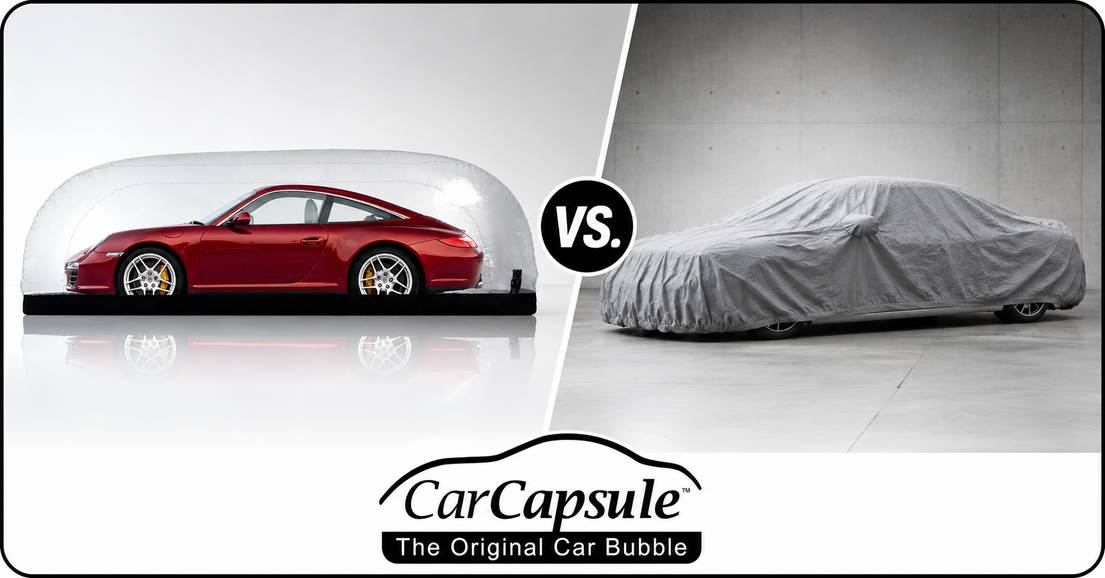
Inflatable Car Cover vs. Traditional Car Cover: Which One Actually Protects Your Paint?
Posted by Phil Potocki on 15th Jun 2026
A traditional fabric car cover can scratch your paint every single time you remove it. That's not a worst-case scenario - it's the mechanical reality of any woven material dragging across a clear coat, even a soft one. If you own a Corvette, a restored Porsche, or any vehicle you actually care about, that friction is a problem worth solving. This article breaks down exactly how inflatable car covers and traditional fabric covers differ in their protection mechanisms, and where each one wins or loses depending on your storage situation.
How Traditional Car Covers Work - and Where They Fall Short
A traditional car cover works by draping a fabric shell directly over the vehicle's exterior. The cover sits in contact with every panel, mirror, and trim piece it touches. That contact is the core problem.
Even covers marketed as "scratch-free" or "ultra-soft" rely on friction to stay in place. Dust and grit that settle on the cover's interior surface get pressed against the paint by the weight of the fabric itself. Wind makes this worse: a loose cover flapping in a breeze acts like a slow-motion sanding block across your hood and fenders. Bob Batz, a longtime car enthusiast, documented exactly this problem before switching to a CarCapsule - his story illustrates how fine scratches accumulate invisibly over months of covered storage.
Moisture is the second major failure point. Fabric covers breathe, which sounds like a feature until you realize that "breathable" also means condensation can form on the inside surface when temperatures drop overnight. That trapped moisture sits against steel, aluminum, and painted surfaces. According to the National Association of Corrosion Engineers, corrosion costs U.S. vehicle owners billions annually - and enclosed, humid microenvironments accelerate the process significantly.
The Problem with Contact-Based Protection
The fundamental design of a fabric cover assumes contact is safe. For short-term outdoor use in mild conditions, it can be acceptable. For long-term storage of a vehicle you're trying to preserve, contact-based protection is a structural compromise. Every install and removal cycle adds risk. There's no way around that physics.
Traditional covers also do nothing to address airborne contamination inside an enclosed space. Dust, insect debris, and humidity cycle in through the fabric's weave. For a car stored in a garage over winter, a fabric cover provides a psychological sense of protection more than an engineered one.
How Inflatable Car Covers Create a Superior Protective Environment
An inflatable car cover - specifically CarCapsule's patented storage bubble - operates on a completely different principle: the vehicle never touches the cover at all.
CarCapsule invented this category in 1991 and holds the original patent on the inflatable vehicle storage bubble. The system works by inflating a clear PVC enclosure around the vehicle using a continuous, low-pressure filtered airflow. That positive air pressure keeps the cover's walls expanded away from every surface of the car. The vehicle sits inside a pressurized clean-air environment, not under a fabric shell.
The filtered airflow is the critical detail most competitors gloss over. CarCapsule units use a continuously running blower motor with a replaceable filter that traps airborne particles before they enter the enclosure. Dust doesn't settle on the paint because clean, filtered air is always circulating. Moisture doesn't condense on surfaces because the air movement prevents the stagnant humidity that causes condensation.
Inflatable Hail Covers vs. CarCapsule: A Critical Distinction
Most products ranking on Amazon for "inflatable car cover" are hail airbag systems, not storage solutions. These are pressure-inflated PVC bladders designed to deploy over a vehicle when a storm warning sounds. They work by contact, sitting directly on the car's surface, and are rated for single-event hail protection. They are not designed for long-term storage, they do not circulate filtered air, and most are not meant to remain installed for more than a few hours.
CarCapsule's outdoor units - including the all-season outdoor CarCapsule built for hail, sleet, and snow - protect against hail as a byproduct of their rigid inflated structure, while also providing continuous filtered airflow for long-term storage. That's a fundamentally different product with a fundamentally different engineering approach. One is an emergency airbag. The other is a permanent storage environment.
Head-to-Head Comparison: Paint Protection, Moisture, and Dust Control
Here's how the two approaches stack up across the protection factors that matter most for long-term vehicle storage.
| Protection Factor | Traditional Fabric Cover | CarCapsule Inflatable Bubble |
|---|---|---|
| Paint contact | Direct contact on every panel | Zero contact - pressurized air gap |
| Scratch risk | High - friction on install, removal, and wind movement | None during storage; minimal on entry/exit |
| Dust control | Partial - dust penetrates weave over time | Continuous filtered airflow removes airborne particles |
| Moisture and condensation | Trap-prone, especially overnight temperature swings | Active air circulation prevents condensation buildup |
| Rodent protection | None - fabric offers no barrier | Sealed enclosure blocks rodent entry |
| Long-term storage suitability | Marginal - risk compounds over months | Designed specifically for long-term storage |
| Hail protection | None | Rigid inflated structure absorbs impact (outdoor models) |
| Display capability | No - car is hidden under fabric | Yes - clear PVC allows full visibility |
| Upfront cost | $30 to $200 | $300 to $900+ depending on model and size |
| Long-term value | Low - paint correction costs exceed cover savings | High - prevents damage that costs thousands to repair |
The cost comparison deserves a harder look. A single paint correction session on a collector car - the kind of professional polishing required to remove the fine scratches that accumulate under a fabric cover - typically runs $500 to $1,500 or more depending on the vehicle and severity. A CarCapsule unit that prevents that damage over three to five years of storage doesn't just pay for itself. It pays for itself several times over.
Indoor vs. Outdoor Use: Which Cover Type Wins in Each Setting?
Garage and Indoor Storage
For vehicles stored in a garage, a fabric cover's only real job is keeping dust off the paint. It does this imperfectly, and every removal adds wear. The Indoor CarCapsule eliminates both problems: the clear bubble keeps dust out completely while the filtered air system maintains a clean interior environment. You can also see the car through the enclosure, which matters if it's a display piece.
For collectors who want to go further, the Indoor Showcase takes the concept to a premium display level, with LED lighting options and a presentation-grade clear enclosure. It's the difference between storing a car and presenting it.
Fabric covers win on cost and simplicity for basic indoor use. If your storage environment is climate-controlled, clean, and the vehicle comes out frequently, a quality fabric cover is a defensible choice. The moment you're storing a vehicle for more than 60 days or the storage environment has temperature swings, humidity, or dust, the physics start working against you.
Outdoor and Ungaraged Storage
Outdoor storage is where fabric covers fail most visibly and most expensively. UV exposure degrades both the cover material and the paint beneath it. Rain saturates the fabric and holds moisture against body panels for hours after the storm passes. Wind flutter creates constant abrasion. None of these are edge cases - they're the normal operating conditions of outdoor storage.
The Outdoor CarCapsule is purpose-built for this environment. The inflated structure resists wind loading, the sealed design keeps rain and debris outside the enclosure, and the filtered airflow continues to operate regardless of external weather conditions. For Corvette owners, Porsche collectors, or anyone storing a vehicle without a garage, this is the category that matters most. The Corvette-specific CarCapsule fitment page covers sizing and setup for one of the most common collector vehicles in the country.
A University of Michigan Transportation Research Institute study on long-term vehicle storage confirmed that outdoor-stored vehicles experience significantly higher rates of corrosion, UV paint degradation, and mechanical deterioration compared to garaged vehicles. An outdoor inflatable bubble doesn't replicate a garage, but it creates a controlled microenvironment that dramatically narrows that gap.
Why CarCapsule Has Been the Gold Standard in Vehicle Storage Since 1991
CarCapsule didn't enter an existing market. It created one. The original patent for the inflatable vehicle storage bubble was filed in 1991, making CarCapsule the category's inventor and longest-running manufacturer. That history matters because it represents over three decades of real-world refinement: blower motor designs tested across thousands of installs, PVC formulations tuned for clarity and durability, and fitment data accumulated across virtually every vehicle platform on the market.
Motor Trend recognized CarCapsule as a Top 10 Most Innovative Car Care Product, which is the kind of editorial validation that comes from independent evaluation, not marketing. That recognition reflects what actual car people think of the product when they use it seriously.
For Jeep owners, Porsche collectors, or anyone with a specific fitment question, the Jeep-specific CarCapsule page is a useful starting point for understanding how the system adapts to different vehicle profiles and heights. CarCapsule builds units for standard sedans, SUVs, trucks, motorcycles, and boats - each with sizing calibrated to the vehicle category.
A practical fitment note: size your CarCapsule to your vehicle's length plus approximately two feet of clearance on each end. This ensures the blower motor maintains consistent air pressure without straining, and that entry and exit don't risk contact with the enclosure walls.
CarCapsule backs every unit with a one-year warranty and offers financing through Affirm for buyers who want to spread the cost. Given that a single paint correction job can cost more than an entry-level CarCapsule unit, the math on protection versus cost is straightforward.
The full comparison of CarCapsule's approach versus standard covers is covered in depth in this breakdown of why not all covers operate on the same principles. The engineering differences are real, measurable, and directly relevant to what happens to your paint over the course of a storage season.
Find the Right CarCapsule for Your Vehicle - Shop Storage Solutions
The bottom line: a traditional fabric cover is a compromise that costs less upfront and more over time. An inflatable storage bubble from CarCapsule is an engineered solution from the original patent holder that eliminates contact-based scratching, active moisture risk, dust infiltration, and rodent access simultaneously. For any vehicle worth protecting, that's not a close comparison.
Browse the full CarCapsule lineup to find the right fit for your vehicle, your storage environment, and your budget. Indoor units, outdoor units, showcase models, and motorcycle capsules are all available with sizing guides and expert support. You can also reach CarCapsule directly at (219) 945-9493 for sizing or custom fitment questions.
Frequently Asked Questions
Can an inflatable car cover cause scratches on paint?
CarCapsule's inflatable storage bubble maintains positive air pressure that keeps the enclosure walls separated from the vehicle's surface at all times during storage. There is no fabric-to-paint contact while the unit is inflated. The only point of potential contact is during entry and exit through the zippered opening, which can be managed with care during setup. This is categorically different from fabric covers, which create friction on every install and removal.
Do traditional car covers trap moisture and cause rust?
Yes, this is a well-documented problem. Fabric car covers breathe, which allows moisture from temperature changes to enter and condense on interior surfaces. If the cover fits tightly and the storage environment experiences overnight temperature swings, moisture can sit against metal body panels and wheel wells for hours. Over weeks and months of storage, this creates ideal conditions for surface corrosion. CarCapsule's continuous filtered airflow actively prevents this by keeping air circulating inside the sealed enclosure.
Are inflatable car covers worth the investment for long-term storage?
For storage periods longer than 60 days, the answer is yes for any vehicle worth more than a few thousand dollars. A single paint correction session to remove scratches caused by a fabric cover costs $500 to $1,500 or more. A rodent nest inside an engine bay can cost $2,000 to $5,000 to remediate. A CarCapsule unit that prevents both problems over multiple storage seasons is a straightforward financial decision, not just a luxury purchase.
Can I use a CarCapsule inflatable cover outdoors?
Yes. CarCapsule offers dedicated outdoor models, including an all-season unit rated for hail, sleet, and snow. The outdoor capsule uses the same filtered airflow system as the indoor model but is built with materials and anchoring systems designed for wind resistance and weather exposure. It creates a controlled microenvironment around the vehicle regardless of external weather conditions, making it a practical solution for collectors and enthusiasts without access to a garage.
How does an inflatable car cover protect against dust compared to a traditional cover?
A traditional fabric cover reduces dust exposure but doesn't eliminate it. Dust settles on the cover's outer surface and works through the weave over time, accumulating on the paint beneath. CarCapsule's sealed enclosure combined with continuous filtered airflow creates a positive-pressure clean-air environment inside the bubble. Because the internal air pressure is slightly higher than the outside, unfiltered outside air cannot infiltrate the enclosure. Dust simply has no pathway to reach the vehicle's surface.