

How to Store a Motorcycle Outside Without a Garage (And Keep It Protected Year-Round)
Posted by Phil Potocki on 8th Jun 2026
A standard motorcycle cover fails within one riding season. UV rays break down the fabric, wind works it loose, and trapped condensation underneath creates the exact humid microclimate that accelerates rust on your frame, exhaust, and carburetors. If you're storing a bike outside without a garage, a cover alone is not a storage plan. It's a delay.
This guide walks through every step of outdoor motorcycle storage the right way: from pre-storage prep to choosing weatherproof protection that actually works long-term. Whether you're winterizing a cruiser in Minnesota or parking a commuter bike outside a city apartment year-round, the process is the same.
Why Outdoor Motorcycle Storage Is Riskier Than You Think
Most riders underestimate how aggressively outdoor exposure degrades a parked motorcycle. A bike sitting under a tarp for six months faces four distinct threats simultaneously, and most DIY solutions address only one or two of them.
- Moisture and condensation: Temperature swings between day and night cause water vapor to condense inside your engine, fuel system, and electrical connections. According to the U.S. Environmental Protection Agency, humid environments accelerate metal corrosion at rates up to five times faster than dry conditions.
- UV radiation: Direct sun exposure degrades rubber seals, seat vinyl, and plastic fairings. The U.S. Department of Energy notes that UV-induced polymer degradation is among the leading causes of premature material failure in outdoor environments.
- Rodent intrusion: A parked, undisturbed motorcycle is an ideal nesting site. Mice chew through wiring harnesses and air filter housings, and the damage often isn't discovered until spring startup.
- Wind abrasion: A cover that flaps repeatedly against painted bodywork creates microscopic scratches that compound into dull, oxidized paint over a single winter.
The mistake most riders make is treating outdoor storage as a single-variable problem. It isn't. Solving it requires addressing all four threats at once.
Step 1: Prep Your Motorcycle Before Storing It Outside
What you do before you cover the bike matters as much as the cover itself. Storing a motorcycle with contaminated fuel, a weak battery, or bare metal surfaces turns a six-month storage period into a repair job.
Fuel System
Add a fuel stabilizer rated for at least 12 months of protection, run the engine for five minutes to circulate it through the carburetors or injectors, then top off the tank. A full tank leaves no airspace for condensation to form. Ethanol-blended pump gas begins to degrade in as little as 30 days, according to fuel chemistry data published by the U.S. Alternative Fuels Data Center, so this step is not optional.
Battery
Either remove the battery and store it indoors, or connect it to a trickle charger or battery tender designed for long-term maintenance charging. A discharged battery left in freezing temperatures sulfates permanently. Most quality chargers shut off automatically at full charge and restart when voltage drops, so there's no risk of overcharging.
Fluids and Lubrication
Change the engine oil before storage, not after. Used oil contains combustion byproducts and acids that corrode engine internals over months of contact. Check coolant concentration if your bike is liquid-cooled. Lube the chain, cables, and pivot points. Spray exposed metal surfaces, including axles and footpeg pins, with a corrosion inhibitor like ACF-50 or WD-40 Specialist Long-Term Corrosion Inhibitor.
Tires
Inflate tires to the maximum recommended pressure. If the bike will sit for more than two months, place it on a paddock stand to keep weight off the contact patches and prevent flat spots. A tire left under load on cold pavement for a full winter can develop permanent deformation.
Wash and Wax
Clean the bike thoroughly before covering it. Any grit, bird droppings, or bug residue left on painted surfaces will bond chemically to the clear coat over months. Apply a quality wax or paint sealant to all painted and chrome surfaces before storage.
Step 2: Choose the Right Weatherproof Protection for Your Bike
This is where most outdoor motorcycle storage guides go wrong. They treat a basic fabric cover as the endpoint. It isn't.
Fabric Covers: What They Can and Cannot Do
A quality motorcycle-specific cover, made from multi-layer polyester with a heat shield over the exhaust area and a soft inner lining, is the minimum acceptable standard for outdoor parking. It should have vents to reduce wind lift and tie-down straps or a cable lock slot to prevent theft. Brands like Nelson-Rigg and Dowco make covers that hold up reasonably well for short-term outdoor exposure.
What a fabric cover cannot do: eliminate condensation underneath it, prevent rodents from accessing the bike, stop UV from degrading your seat and rubber components, or stay securely in place during high winds. These are structural limitations of the category, not brand-specific failures.
Hard Shelter Structures: Better, But Not Ideal
Pre-fabricated metal or polycarbonate lean-tos and motorcycle shelters offer more protection than a cover. They block wind and most UV. The problems: they require a level concrete or paver surface, most require permanent anchoring, and none of them address condensation or rodents. They're also bulky and difficult to relocate.
Inflatable Enclosures: The Option Most Riders Don't Know Exists
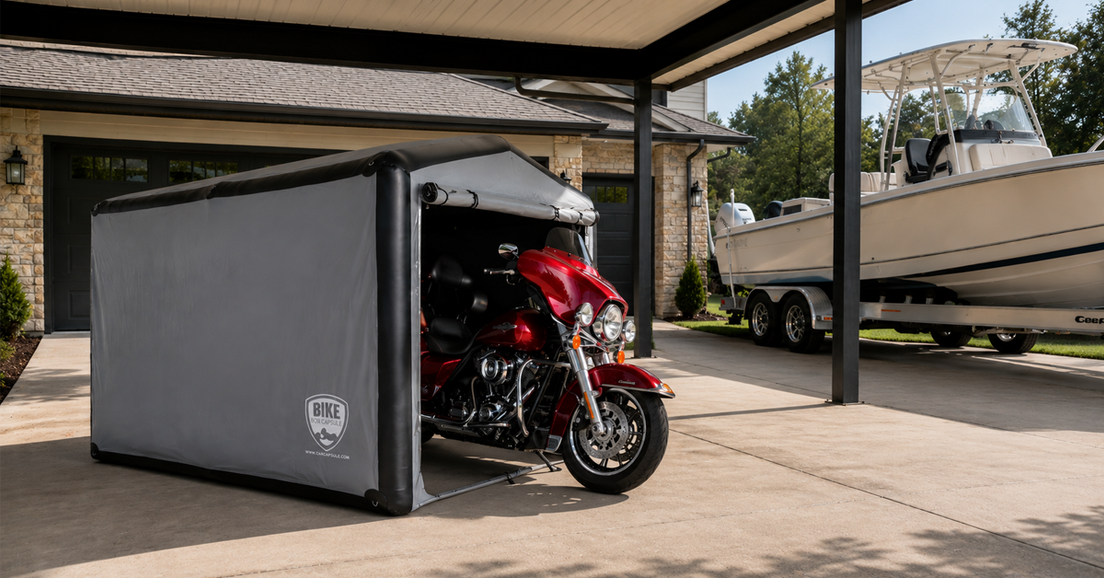
CarCapsule has manufactured inflatable, ventilated vehicle storage enclosures since 1991, originally patented as the first product of its kind. The outdoor motorcycle-specific version, the Outdoor Bike Showcase, uses a continuously inflated clear PVC structure with filtered airflow to create a controlled storage environment around the motorcycle.
Because the enclosure maintains positive air pressure through filtered intake fans, outside air (with its humidity and particulates) cannot enter. Condensation doesn't form inside because the air temperature inside the enclosure stays more consistent than the ambient air around it. The clear PVC panels let you display the bike while it's stored, and UV-resistant materials protect against sun degradation.
This approach is categorically different from a cover or a shed. It's worth reading about how the Outdoor Bike Showcase works in practice if you're considering long-term outdoor storage.
Step 3: Guard Against Moisture, UV Rays, and Temperature Swings
Even with a good cover or enclosure in place, active moisture management separates a bike that comes out of storage in perfect condition from one that needs a full service before it'll start.
Desiccants and Moisture Absorbers
If you're using a fabric cover or an unventilated shelter, place silica gel desiccant packets inside the airbox, under the seat, and near the electrical connections. Replace them every 30 to 60 days during extended storage. A single large desiccant canister rated for enclosed spaces (typically 150 to 300 cubic feet) placed under the bike is effective for full-enclosure situations without active ventilation.
Ventilation
Stagnant air is your enemy. Any enclosed storage situation needs either passive ventilation (screened vents at opposite ends) or active ventilation (a low-draw fan moving air continuously). CarCapsule's outdoor enclosures use filtered fans specifically for this reason: the filtered airflow keeps humidity low, discourages mold and mildew, and keeps the enclosure inflated simultaneously. It's an elegant solution to a real engineering problem.
Ground Moisture
If the bike sits on concrete or asphalt, place a rubber mat or plywood sheet under the tires. Concrete is porous and wicks moisture upward, especially in freeze-thaw cycles. That moisture migrates into your tires and, over time, into the lower portions of the frame.
Step 4: Secure Your Motorcycle Against Theft and Vandalism
An outdoor motorcycle is a target. Covered bikes, paradoxically, can attract more attention from thieves because the cover signals that the owner cares about the bike, which usually means it's valuable. Security and storage are the same problem.
Layered Locking
Use at minimum two independent locks: a disc lock on the front rotor and a heavy-gauge chain lock through the rear wheel secured to a ground anchor or fixed structure. A thief who encounters two locks requiring two different tools will almost always move on. Oxford, Kryptonite, and Abus all make chain locks rated for outdoor exposure.
Ground Anchors
A steel ground anchor bolted through a concrete surface (using a hammer drill and expansion bolts rated for the anchor load) gives you a permanent secure point that cannot be removed without serious equipment. For renters or anyone who can't modify the surface, a folded heavy-gauge chain run under a vehicle tire or through a fixed structure serves as a reasonable alternative.
How an Enclosure Adds Security
An opaque or semi-opaque enclosure removes the visual cue entirely. A locked, inflated enclosure around a motorcycle requires a thief to defeat the enclosure lock, deflate or cut the structure, then defeat the bike locks, in an exposed location. The friction alone deters most opportunistic theft. The CarCapsule Outdoor Bike Showcase includes lockable zipper access, which adds one more layer without adding complexity for the owner.
The Best Long-Term Solution for Outdoor Motorcycle Storage
After more than 30 years building vehicle storage solutions, the consistent pattern CarCapsule has seen is this: riders who rely on fabric covers alone replace them every one to two seasons and still deal with corrosion, rodent damage, and UV degradation. Riders who use a ventilated, enclosed system don't.
One example that illustrates the difference: Greg, a CarCapsule customer, used an outdoor Bike Capsule for 12 consecutive years of outdoor exposure. The enclosure was still structurally sound and performing at the end of that period. That kind of service life is impossible with a fabric cover, regardless of brand.
For motorcycle owners who want the most complete outdoor protection available, the options from CarCapsule's Bike Capsule lineup are worth a close look. The 9-foot Outdoor Powersports Bike Capsule fits most standard motorcycles with clearance to spare, while the Outdoor Bike Showcase adds a display-quality clear panel design for riders who want to see the bike even when it's stored.
For riders storing multiple bikes or looking at broader vehicle protection options, the full range of outdoor vehicle enclosures and storage accessories covers everything from single motorcycles to full-size trucks.
CarCapsule was recognized as a Top 10 Most Innovative Car Care Product by Motor Trend and backs every unit with a one-year warranty. For sizing questions or custom fitment, call (219) 945-9493.
Frequently Asked Questions About Outdoor Motorcycle Storage
Can I store my motorcycle outside in winter?
Yes, with the right preparation. Add fuel stabilizer, change the oil, maintain the battery with a trickle charger, and use a ventilated enclosure or a quality cover with moisture absorbers underneath. Motorcycles stored this way regularly come out of winter storage in excellent condition. The risk isn't winter itself; it's trapped moisture, discharged batteries, and degraded fuel left unaddressed.
Is a motorcycle cover enough protection outside?
For short-term parking (days to a few weeks), a quality cover is adequate. For storage lasting months, a fabric cover alone is not sufficient. It cannot prevent condensation buildup underneath, keep rodents out, or stay securely in place in sustained wind. A ventilated enclosure addresses all three of those failure points.
How do I prevent rust on a motorcycle stored outdoors?
Rust prevention starts before storage: wash and wax all painted surfaces, apply a corrosion inhibitor like ACF-50 to bare metal and electrical connections, change the oil so acids don't sit against internal surfaces, and store the bike in an environment with controlled airflow to prevent condensation. A ventilated enclosure is the most effective single investment for long-term rust prevention in outdoor conditions.
What is the best outdoor motorcycle storage solution?
A purpose-built, ventilated enclosure like the CarCapsule Outdoor Bike Showcase is the most complete solution for long-term outdoor motorcycle storage. It combines continuous filtered airflow to prevent moisture buildup, UV-resistant materials, lockable access, and a clear display-quality exterior. For riders who want to protect a motorcycle outside for a full season or longer, it outperforms fabric covers and open shelters on every relevant metric.
How do I keep moisture out of my motorcycle engine during storage?
Change the oil before storage (not after) to remove combustion acids, top off the fuel tank with stabilizer to eliminate airspace where condensation forms, and plug the exhaust outlet with a clean rag or foam plug to prevent humid air from entering. For the external environment, prioritize ventilated storage over sealed, unventilated enclosures, since stagnant air holds humidity while moving filtered air carries it away.
Explore the Bike Capsule - Purpose-Built Outdoor Protection for Your Motorcycle. Find your size, compare models, or call (219) 945-9493 for fitment help.