

Hail Damage on Cars: How to Protect Your Vehicle Before the Storm Hits
Posted by Phil Potocki on 6th Jul 2026
A single hailstorm can generate repair bills between $2,500 and $15,000 depending on hail size and how long your car sits exposed. In Texas, Colorado, Oklahoma, Kansas, and Nebraska alone, insurers process more than 1.5 million hail damage claims every spring. The vehicles that escape unscathed almost never had a tarp thrown over them. They had a hail bubble for a car that created an actual physical air barrier between the ice and the paint.
This post walks you through exactly how hail damages a vehicle, how an inflatable car bubble stops that damage before it starts, and how to choose and deploy the right CarCapsule for your situation before the next storm rolls in.
What Hail Does to Your Car (And Why the Damage Adds Up Fast)
Hail damage is deceptive. A stone the size of a golf ball falls at roughly 44 mph and delivers a focused impact load that sheet metal simply cannot absorb without deforming. The dent is only the beginning of the problem.
Here is the damage chain that plays out after most hailstorms:
- Paint micro-cracks form on impact, even when no visible chip appears immediately.
- Dents break the paint-to-metal bond at the edges of each depression, exposing bare metal.
- Moisture enters the micro-cracks within days, starting the oxidation cycle.
- Surface rust appears within weeks on unprotected steel panels, especially on older vehicles with thinner factory coatings.
According to the Insurance Information Institute, hail causes approximately $14 billion in property damage annually in the United States, with vehicles accounting for a significant portion of that figure. Paintless dent repair (PDR) costs $75 to $150 per dent, and a badly hailed hood can require 40 or more individual repairs. That is before you factor in paint correction, trim replacement, or windshield work.
For a collector car, a classic Corvette, a restored Mustang, or a numbers-matching Camaro, even a single hailstorm can permanently affect resale value in ways that PDR cannot fully reverse. That is not hype. It is the reason serious car owners in hail-prone states treat storm preparation like a scheduled maintenance item.
You can read more about how hail dents trigger the long-term rust cycle in our detailed breakdown of how to protect your car from hail damage.
What Is a Hail Bubble for Cars and How Does It Work?
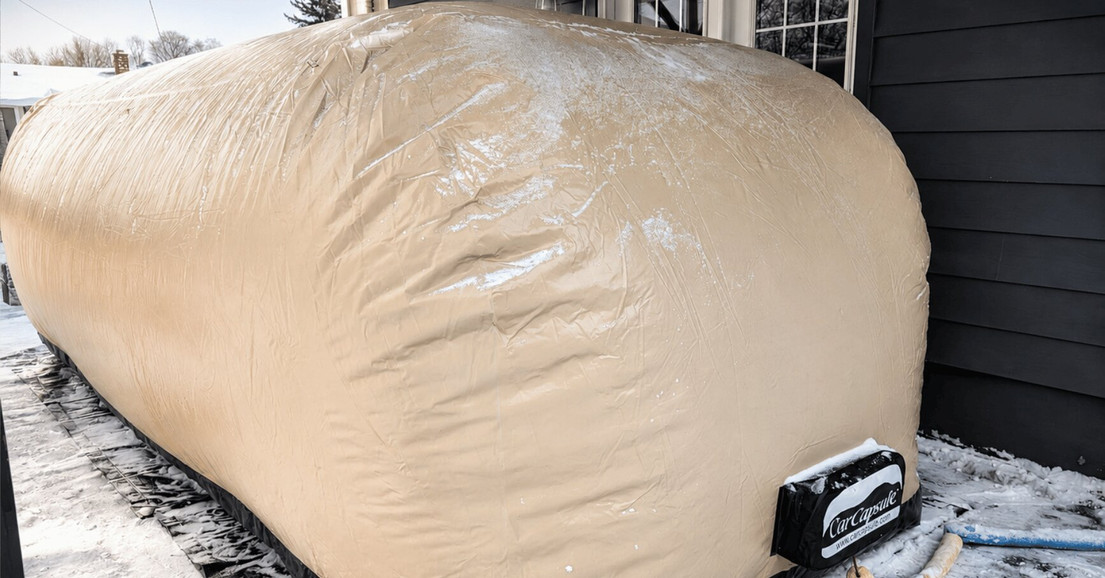
A hail bubble for a car is an inflatable, sealed enclosure that surrounds the entire vehicle and maintains a continuous cushion of filtered, pressurized air between the exterior of the car and the outside world. It is not a cover. It is not a tarp. The air column itself is the protection layer.
CarCapsule invented this category. The original vehicle storage bubble was patented in 1991, and for more than 30 years CarCapsule has been the manufacturer that every generic alternative is trying to copy. Motor Trend named CarCapsule a Top 10 Most Innovative Car Care Product, not because of marketing, but because pressurized inflatable enclosures solve problems that flat fabric covers physically cannot.
Why Air Pressure Changes Everything
A standard car cover sits directly on the vehicle surface. When a hailstone hits it, the cover transfers 100 percent of the kinetic energy straight into the paint. The fabric absorbs almost nothing because there is no deformation distance available.
A CarCapsule works differently. The continuous airflow from the integrated fan keeps the clear PVC shell inflated several inches away from the car surface at all times. When a hailstone strikes the outer shell, the shell deflects inward slightly, dispersing the impact energy across the air column before any force reaches the vehicle. Think of it like the crumple zone in a modern car: the space between the outer wall and the occupant is what saves the occupant.
The Continuous Filtered Airflow System
The same fan that inflates the capsule runs continuously, pulling outside air through a fine filter and circulating it inside the sealed enclosure. This does two things beyond hail protection. It prevents the humidity buildup that causes condensation and mildew on stored vehicles, and it keeps airborne dust and contaminants outside the barrier. One system handles hail defense, dust control, and moisture management simultaneously.
Have questions about how the system works before you buy? The CarCapsule FAQ covers common sizing, setup, and compatibility questions in detail.
Indoor vs. Outdoor Hail Protection: Which CarCapsule Is Right for You?
The right choice depends on where the vehicle lives, not just what you want to protect it from.
You Have a Garage
If your car is garaged but you want full-time dust, moisture, and rodent protection with the added benefit of hail-proof coverage when storms threaten, the Indoor CarCapsule is the correct solution. It inflates inside the garage bay, wraps the vehicle completely, and runs on standard household current. It is also the right choice for long-term storage of a collector vehicle you don't drive daily.
No Garage, or You Park Outside
This is where hail exposure is most severe, and where most generic covers fail completely. The Outdoor CarCapsule is built specifically for vehicles that live outside. The shell material is UV-stabilized, the anchoring system is designed to handle wind loads, and the sealed enclosure stops rain, sleet, and hail from reaching the vehicle surface year-round. If you are in Texas, Colorado, or anywhere in the US hail belt, this is the unit that earns its cost back in a single storm season.
You Want Protection and Display
For show cars, collector pieces, or any vehicle you want to show off while keeping protected, the Outdoor Showcase combines full enclosure protection with a clear shell that lets the vehicle be seen without exposing it. It handles hail, UV, and weather the same way the standard outdoor unit does, with the visual presentation of a display case.
Quick Comparison
| Scenario | Recommended Unit |
|---|---|
| Garaged car, daily or seasonal storage | Indoor CarCapsule |
| No garage, full outdoor exposure | Outdoor CarCapsule |
| Outdoor storage, collector or show car | Outdoor Showcase |
| Motorcycle storage | BikeCapsule |
Sizing tip: Measure your vehicle's total length and add approximately 2 feet of clearance. That number is your minimum capsule length. When in doubt, size up rather than down. A capsule that fits snugly is harder to deploy and may not inflate uniformly around taller vehicles like trucks and SUVs.
Financing is available through Affirm if you'd prefer to spread the cost across monthly payments.
Step-by-Step: How to Set Up Your Car Hail Bubble Before a Storm
The most common mistake people make with inflatable vehicle protection is waiting until the storm warning is already active. A CarCapsule deploys in under 10 minutes, but you want the system fully inflated and confirmed before conditions deteriorate. Here is the correct process.
What You Need
- Your CarCapsule (sized correctly for the vehicle)
- Access to a standard 110V outdoor-rated outlet (outdoor units)
- A clean, flat surface under the vehicle
- 5 to 10 minutes of setup time
Step 1: Position the Base
Lay the capsule base flat under and around the vehicle. The base zipper panel should align with the driver's side door for easiest access later. Smooth out any major folds before proceeding. A wrinkled base creates uneven inflation and can leave pressure gaps near the rocker panels.
Step 2: Connect the Fan Unit
Attach the fan to the designated inlet port on the capsule. For outdoor deployments, confirm the power cord is routed so it won't be submerged if water pools near the vehicle. The fan runs continuously, so electrical safety is not optional.
Step 3: Inflate the Shell
Power on the fan. The capsule reaches full inflation in roughly 3 to 5 minutes depending on capsule size. Watch the shell as it rises and confirm it is clearing the hood, roof, and trunk evenly. If one section lags, check for an unsealed zipper section or a fold in the base restricting airflow.
Step 4: Seal and Secure
Close and zip all access points. For outdoor units, secure the anchor points at the base perimeter. In high-wind conditions, add supplemental weight to anchor tabs if your surface doesn't allow staking. Do not skip anchoring. A fully inflated but unanchored capsule in 40 mph gusts is a problem.
Step 5: Confirm Pressure and Leave It Running
The capsule should feel firm to light hand pressure with the fan running. If it feels soft, check for a partially open zipper. Leave the fan running for the duration of the storm. The continuous airflow is what maintains the protective air column. Turning it off mid-storm defeats the system.
Want to see the full setup process in action before your unit arrives? The CarCapsule video library has step-by-step installation footage for multiple vehicle types.
Additional Tips for Protecting Your Vehicle During Hail Season
Check Storm Forecasts at the Regional Level
The NOAA Storm Prediction Center publishes daily convective outlooks that map hail threat by region. During April through June, checking this the night before instead of the morning of gives you time to deploy your capsule calmly rather than rushing before a squall line arrives.
Don't Rely on a Parking Structure During Active Hail Season
Open-sided parking structures offer overhead protection but almost no side coverage. Hail driven by wind at 30 to 50 mph arrives at angles that a flat roof canopy cannot block. If you're in Amarillo, Denver, or Oklahoma City during May and June, a parking structure is better than nothing but not a substitute for a sealed enclosure.
Year-Round Is More Cost-Effective Than Seasonal
Car owners who deploy a CarCapsule only for hail season miss nine months of dust protection, UV fading prevention, and rodent deterrence. The unit's value compounds when it runs year-round. The hail season benefit is real, but it's one of five or six threats the capsule eliminates simultaneously.
Inspect Paint After Any Storm, Even If the Capsule Was Deployed
If a severe storm with golf ball or larger hail moved through, do a visual inspection of the capsule shell after the event. The shell is designed to take the impact. Look for any unusual indentations in the shell material, confirm the fan ran through the storm, and check that all anchor points held. In the rare event a connection failed mid-storm, you want to know before assuming the vehicle is clean.
The Bottom Line: Act Before the Season Starts
A hail bubble for a car is the only hail protection method that puts a physical air buffer between the storm and your paint. Tarps transfer impact directly. Carports leave flanks exposed. A CarCapsule, inflated and sealed before the storm arrives, is the only passive solution that addresses hail, wind-driven debris, moisture, and dust in a single system.
CarCapsule has been building these systems since 1991 and backs every unit with a 1-year warranty. If you're in Texas, Colorado, Oklahoma, Kansas, Nebraska, or anywhere else the hail belt runs, the time to set this up is before the April forecast, not after the April claim.
Find Your CarCapsule: Shop Hail Protection That's Built to Last. Need help with sizing or a custom vehicle? Call us at (219) 945-9493.
Frequently Asked Questions
Can a hail bubble for a car withstand large hailstones?
Yes. The CarCapsule's continuous airflow system keeps the outer PVC shell several inches away from the vehicle surface. When a hailstone strikes the shell, the impact energy disperses across the pressurized air column before reaching the car. The shell itself is rated for standard hail conditions, and the air cushion handles the energy transfer that flat fabric covers cannot absorb.
How quickly can I set up a car hail bubble before a storm?
A CarCapsule inflates in 3 to 5 minutes once the fan is connected, with full setup including positioning and anchoring taking under 10 minutes. The key is deploying it before the storm warning is active, not during it. Keeping the capsule stored near the vehicle during hail season makes same-day setup entirely practical.
Does a hail bubble work for trucks and SUVs, not just cars?
CarCapsules are available in sizes that accommodate full-size trucks, SUVs, and vans. Measure your vehicle's total length and add approximately 2 feet of clearance when selecting a unit. Taller vehicles like crew-cab pickups may require a size up from what the base length alone would suggest, so confirm roof height against the capsule specifications before ordering.
Is a hail protection bubble better than a standard car cover?
For hail specifically, yes. A standard cover sits directly on the paint, which means hailstone impact energy goes straight into the vehicle surface with no absorption buffer. A CarCapsule maintains an air gap between the shell and the car, which is what actually stops dent formation. Standard covers also hold moisture against the paint; the CarCapsule's filtered airflow prevents that entirely.
Can I use a CarCapsule outdoors if I don't have a garage?
The Outdoor CarCapsule and Outdoor Showcase are designed specifically for vehicles that park outside full-time. Both units are UV-stabilized, wind-anchored, and sealed against rain, hail, sleet, and snow. They run on standard outdoor-rated 110V power and are the correct choice for anyone in the US hail belt who parks in a driveway, on a pad, or in an open lot.